Interface catalogue
Every integration between your systems in one register.
ERP and CRM programmes live or die on their integrations, yet the interface landscape is usually undocumented until something breaks. FlowRight gives you one catalogue of every interface between your systems: what moves, how, how often, and whether it is live, planned or being retired.
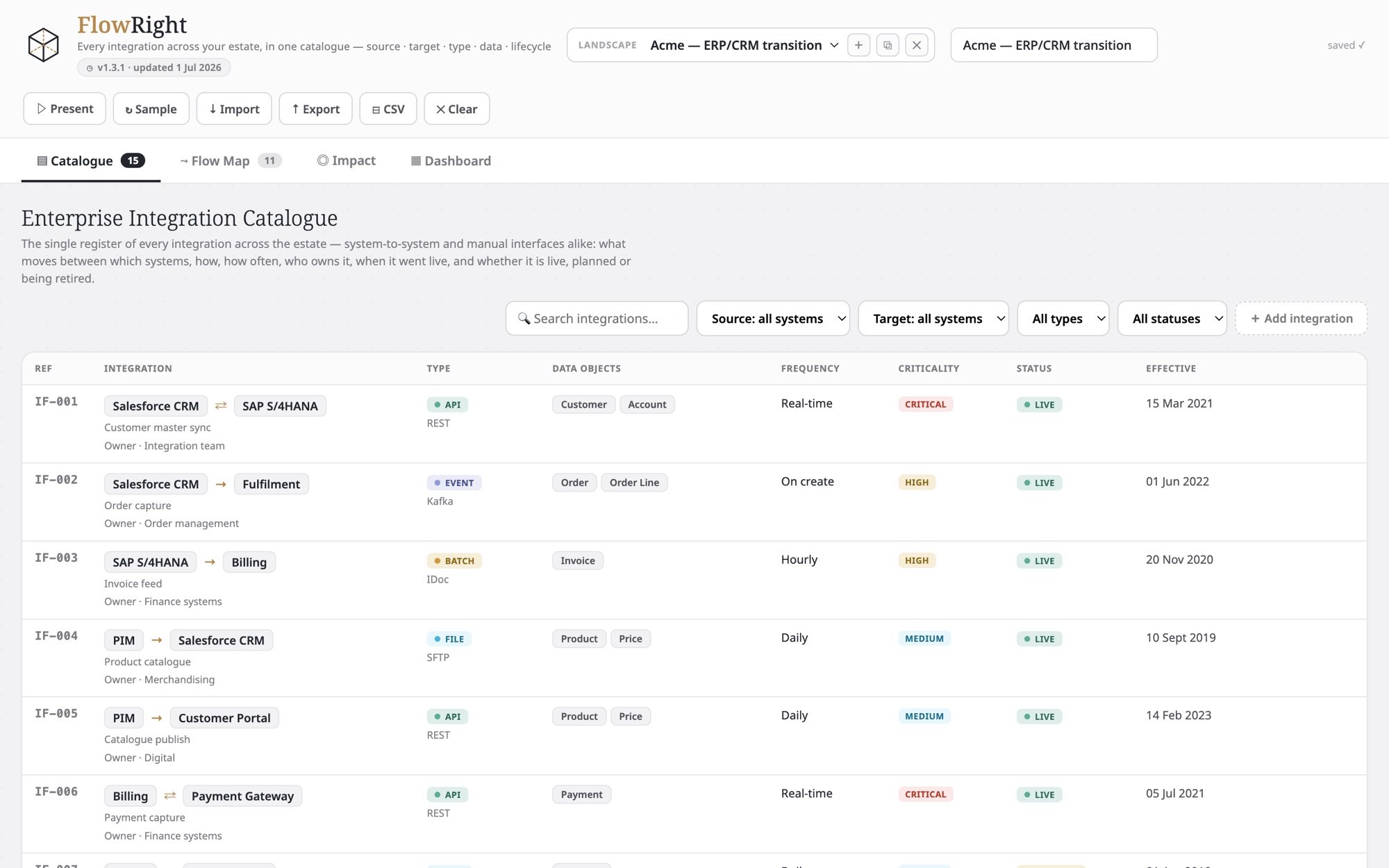
Every integration between your systems in one register.
See clearly which system sends, and which receives.
API, file, batch or event, real-time or scheduled.
Which data each interface carries, linked to RecordRight.
Live, planned or retiring, so transition is visible.
See how many interfaces touch a system before you change it.
Undocumented interfaces hide cost, risk and dependencies. When nobody can see the integration landscape, change is slow and migrations are dangerous. FlowRight makes the interfaces visible, so impact and sequencing are planned rather than discovered.
Solution and integration architects, ERP and CRM programme teams, data architects and delivery leads who need to understand and govern the interfaces across a complex estate.
Typical use cases
FlowRight sits between the applications in CatalogRight and the data in RecordRight, turning a tangle of undocumented integrations into a governed catalogue.
The clearest way to understand it is a short walkthrough against a problem you recognise.